

Becoming No One
What’s left of you when nobody knows your name or a single thing you’ve done.

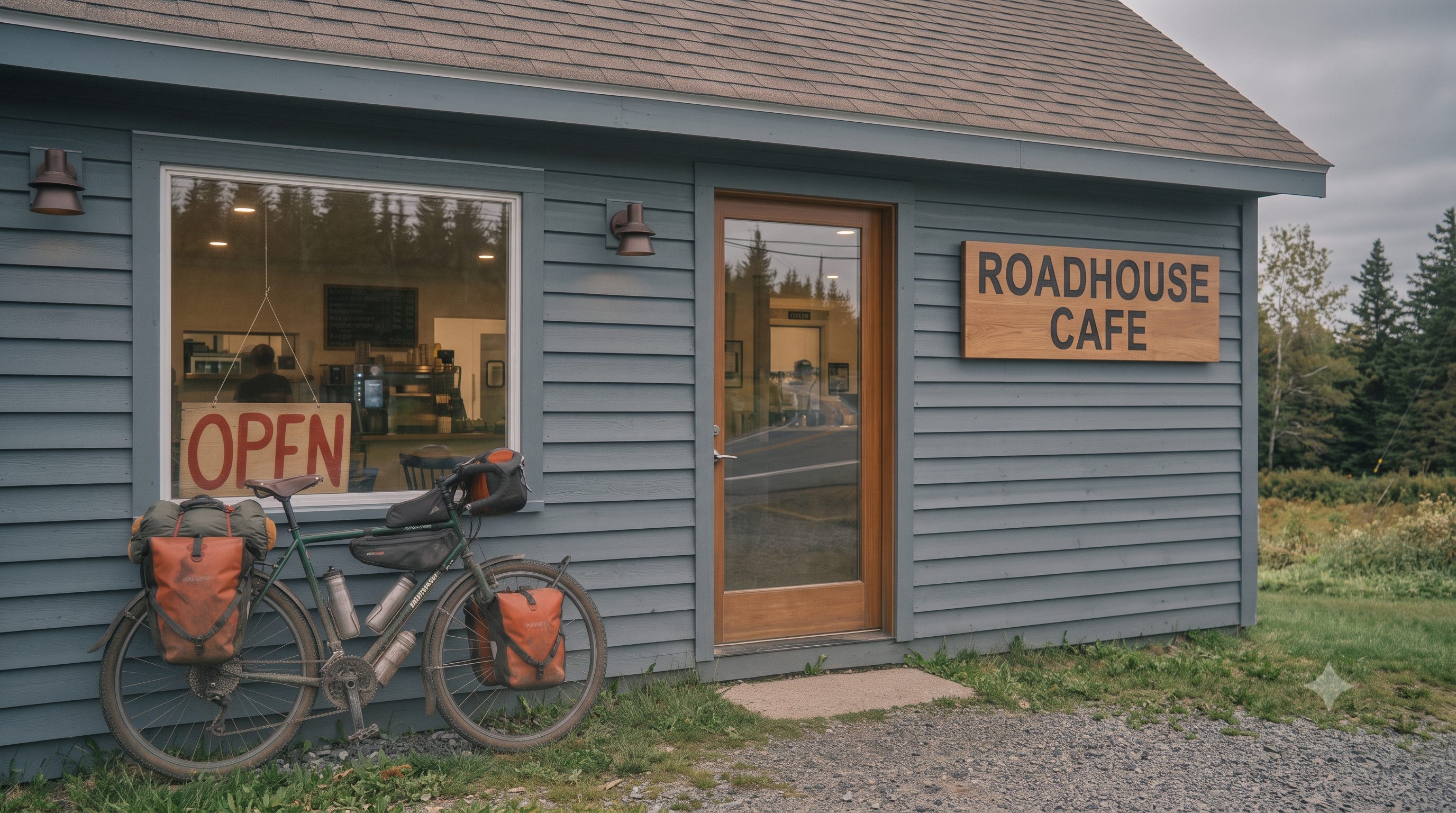
Somewhere on Route 7 east of Sheet Harbour, Nova Scotia, there’s a diner where a waitress called me “dear,” brought me white toast when I’d asked for brown, and knew nothing about me at all. Not my name. Not the businesses or the inbox sitting on a phone I hadn’t charged since Musquodoboit Harbour.
She had a pen behind her ear she never used, and when she topped up the coffee she said, “You’re going the wrong way for a nice day,” and went back to the till. She saw a man in gritty shorts eating eggs at two in the afternoon, and that was the entire file.
I tipped too much and rode away feeling lighter than the bike could explain.
It took me a long time to work out what that lightness was, and it isn’t solitude. You can feel it in a full campground with six other riders talking at once.
The ledger nobody stops paying
At home, you never walk into a room clean. There’s a version of you that arrives about four seconds before you do, assembled from every deal you’ve closed or botched and every year you’ve spent becoming whatever it is people have decided you are. In a small village this runs at industrial strength. I can’t buy milk without being a known quantity to the woman ringing it through. She isn’t wrong about me. That’s what makes it heavy.
None of this is malicious. It’s what communities do. People keep a ledger; reputation is the running balance, and most of us spend a startling amount of daily energy servicing it: managing impressions, staying recognizable. You don’t notice the cost because you’ve never once stopped paying it.
Then you load four bags onto a bicycle and ride somewhere nobody has ever heard of you, and the ledger closes the way a bank branch closes. The records still exist somewhere. Nobody here can access them.
Three questions, and that’s the whole interview
Where did you start? Where are you headed? And aren’t you scared of the trucks?
That’s it. In fifteen years of loaded riding, no stranger has ever asked me what I do for a living while I was straddling the bike. Not once. The bike answers the only question anyone actually has, which is: what is this man’s deal? His deal is that he rides, apparently a long way, and needs calories. File complete.
I’ll admit the file felt thin at first. On day two of last summer’s Maritimes loop I caught myself, mid-sentence, about to tell a man at an Irving that I’d written a book about this. He’d asked whether 45s were hard to change. I was one breath away from handing him a resume. He wanted to know about tires. Somewhere in me a small press secretary was dying, and he did not go quietly.
For the first few days you keep performing to an audience that has left the building. You reach for the introduction nobody asked for. You compose the version of the day you’d tell someone who knows you, and then you look around, and no one knows you, and the anecdote sits there in your helmet like a passenger who missed his stop.
By about day four the performance dies. Not dramatically. It starves. Identity runs on attention, and when you cut the supply the ornamental parts wither off with almost no ceremony at all.
The part where I lied to a man from Guelph
Here’s the bit I’d rather leave out.
Third night, picnic table under a campground shelter, rain coming sideways. A retired couple in a fifth-wheel had taken pity and were feeding me instant coffee. The husband asked what I did back home, and instead of answering I said I was between things at the moment.
I have never in my adult life been between things.
It came out easy, and it sounded good, and he nodded like a man who’d been between things himself once. Then I embellished. Nothing enormous. A shrug about how you get to a certain age and reassess. He said something kind. His wife said something kinder. I sat there in the rain being a man I have never been, and I liked it, and I thought about it for the next thirty kilometres in a way that was not comfortable.
Because the freedom of being no one includes the freedom to be anyone, and there is nobody out there to check. The ledger doesn’t just close. It stops being written. Whatever you say about yourself at a picnic table in a rainstorm becomes true for the duration of the coffee, and if that doesn’t unsettle you a little, then I’d suggest you haven’t sat with it long enough.
I’ve thought about why I did it. The nearest honest answer is that I’d gone four days without anyone reflecting a self back at me, and I wanted to find out what a different one felt like. It felt fine. That’s the part that bothers me.
Who’s left
The question isn’t whether being unknown feels good. It does. The question is who’s still standing there afterward.
I can tell you what I found, for whatever one rider’s inventory is worth. He eats when he’s hungry rather than when the calendar says. He notices which farms have given up and which haven’t, and the sound chip-seal makes under 45s when the temperature drops.
And I can tell you what didn’t survive. The ambition-hum, that low-grade frequency of what’s next and how it will look. The rehearsed opinions I’d been carrying around like business cards. The constant quiet management of what people think, which I would have sworn I didn’t do until I felt it switch off somewhere on the Sunrise Trail like a compressor cycling down.
Those parts evaporated the moment nobody was watching, which tells you everything about them.
They were never load-bearing. They were costume, and I’d worn the costume so many years I’d started billing it as skin.
There’s a stretch on day two or three where this feels less like freedom and more like standing in a room with the lights off. I’ve filled those hours with podcasts before and told myself it was for the company. It wasn’t. If you’ve spent thirty years being somebody, being no one feels like a small death for about a day and a half.
Then it feels like the first honest weather report you’ve had in years.
Even among other cyclists, the anonymity mostly holds. Riders identify each other by rig, not resume. For three days on the Confederation Trail I was known to a rotating cast of strangers as the guy with the orange bags. I have been introduced at conferences with a paragraph of biography, and I’m telling you the orange bags version was more accurate.
The ride home
It doesn’t last, and chasing a permanent version of it is a lonely project best left to people with fewer obligations than me. Somewhere on the last day you cross back into ledger country. The first person who greets you by name hands the whole costume back, warm from storage, and you put it on because you love these people and the costume is partly how they find you.
I’d like to report that I put it on slowly and deliberately. In fact, I was back inside it before the kettle boiled, answering an email about a pallet of cider that had been sitting there for eleven days and could have sat one more.
But something did stay. You’ve now stood in front of the mirror without the whole outfit, and you know which pieces are yours and which are only expected. The reputation and the roles and the accumulated weight of who everyone assumes you’ll be on Tuesday: some of that you’ll shoulder gladly, because it’s real and you built it. Some of it you can quietly leave in the pannier. Nobody checks.
I still think about that waitress. I never learned her name either, which seems like a fair trade. She got my toast wrong, called me dear, told me I was going the wrong way for a nice day, and saw me more clearly than plenty of people who’ve known me twenty years: a hungry man, a long way from somewhere, going somewhere else.
If you’re thinking about disappearing for a week or two yourself, my book Train, Pack & Ride covers the part that comes before the diner: getting the legs and the bags ready to leave. The becoming-no-one part you’ll have to do on your own.
There’s something about the anonymity of long touring that makes space to drop our story lines, and in so doing, make all the space in the world for the tiny beautiful things that matter most. You’ve captured this perfectly. Thank you!
Being no one for a while recharge’s the batteries, I’ve found.