


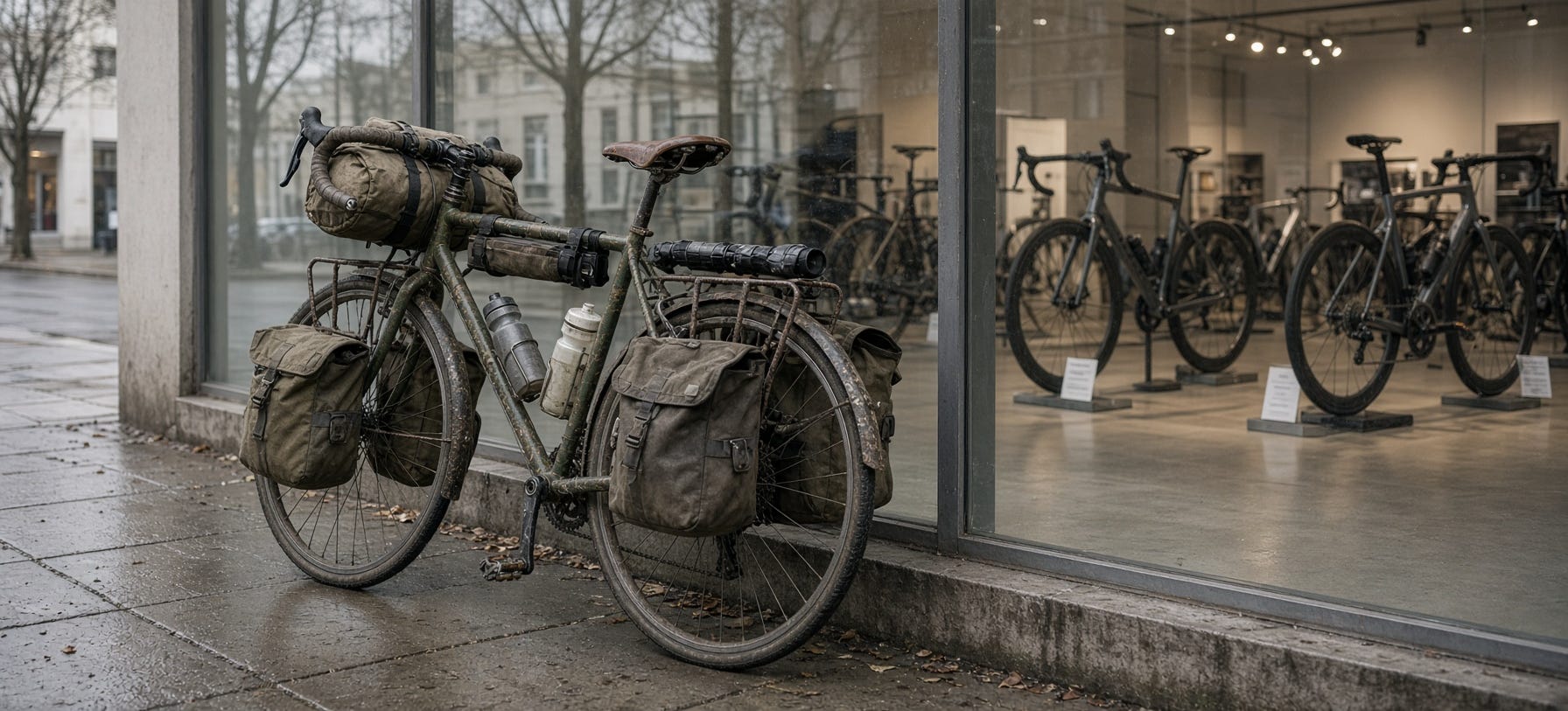
I’ve stood in a bike shop in Halifax and lifted a carbon gravel frame off its hook with two fingers, and I’m not going to pretend it didn’t do something to me. It weighed about what a bottle of wine weighs. The bike I actually tour on is a Surly Long Haul Trucker that was heavy when it was new and has not gotten any lighter since, and it weighs about what a full case of that wine weighs. For a few seconds in that shop I was ready to do something regrettable with a credit card.
Then I did what I do whenever I want something expensive, which is go home and do the arithmetic until the feeling goes away.
The number they leave off the spec sheet
The industry sells you one number: what the bike weighs. Eight and a half kilos for the carbon rig, fourteen for a decent steel tourer with racks, and the salesman lets the gap sit there in the air like it means something.
The weight of the bike is the wrong number. What actually goes up the hill is the bike, plus you, plus everything you bolted and strapped to it because you intend to be gone for a while.
Say you’re 80 kg. Say you’re carrying 30 kg of gear, which is about what a self-supported tour with a tent, a stove and a mild packing problem adds up to. (I’ve weighed my load on a bathroom scale in a hallway in Canning. I wish I hadn’t.)
Steel system: 80 + 14 + 30 = 124 kg. Carbon system: 80 + 8.5 + 30 = 118.5 kg.
Five and a half kilos. Four point four percent of the total, call it four.
And I want to be fair here, because five and a half kilos is not nothing. It’s seven full water bottles. If someone handed you seven water bottles at the bottom of a climb you would have opinions. So the honest question isn’t whether the weight is real. It’s what four percent actually buys you, and that turns out to be a number you can put a stopwatch on.
What five and a half kilos costs you on the road
Weight does two things to a cyclist. It makes you push a little harder against the road, and it makes you push a lot harder against gravity. Air doesn’t care what you weigh. Air only cares how big you are, and a loaded touring bike with four panniers is roughly the size of a garden shed.
So I ran the numbers the way the physics people run them: rolling resistance, drag, grade, and a touring cyclist’s real output. Not a racer’s 250 watts. A hundred. That’s what most of us hold for six hours with a lunch stop, and it’s what produces the low-to-mid teens that show up on every touring cyclist’s GPS at the end of a hilly day, whatever they paid.
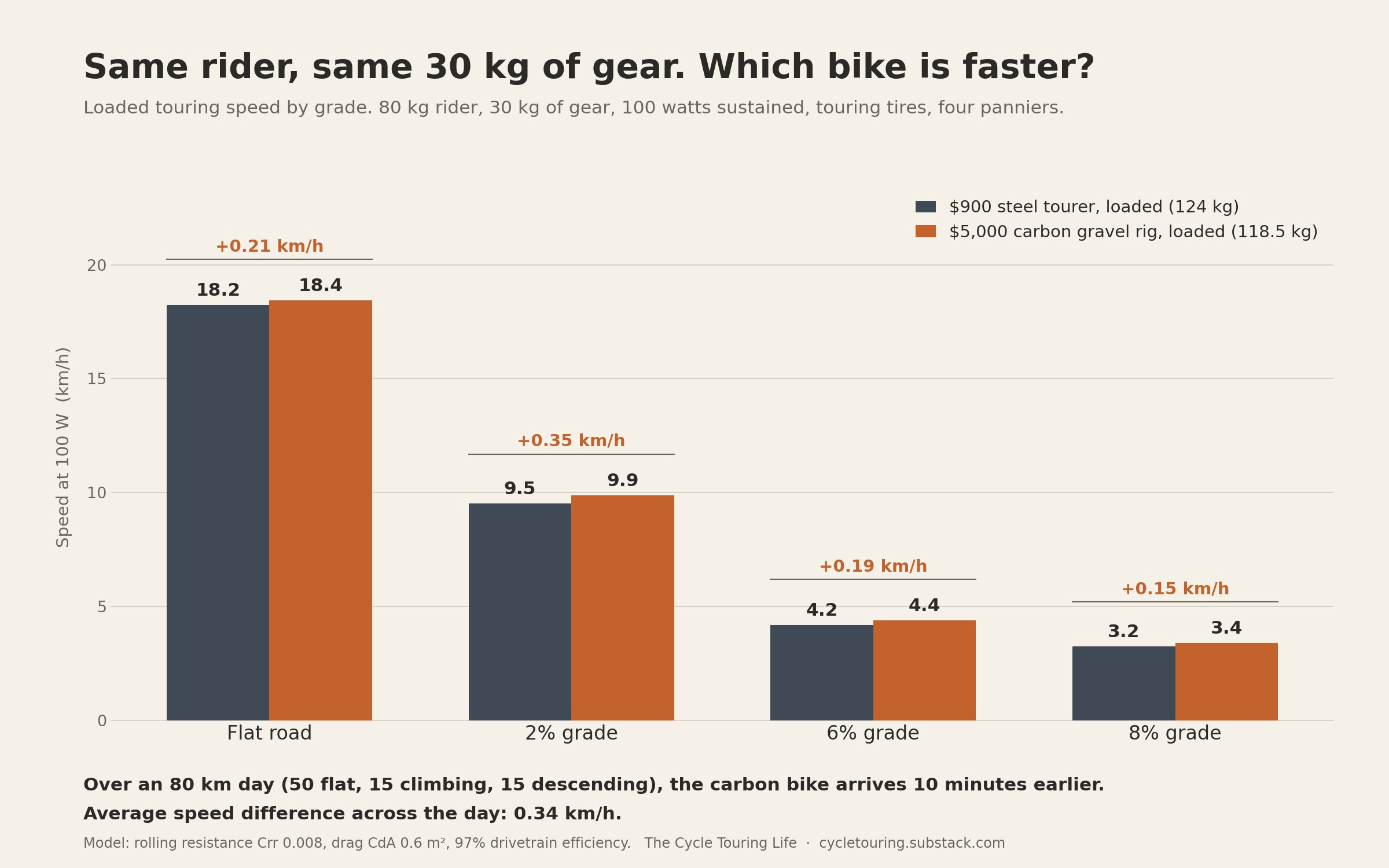
Put that into a real day. Eighty kilometres: fifty flat, fifteen climbing, fifteen coasting down the other side. The steel bike takes six hours and fourteen minutes. The carbon bike takes six hours and four.
Ten minutes. Over an entire day. That works out to 0.34 km/h of average speed, and I’m going to round it to “less than one” because that’s the number I want in your head the next time someone in matching kit explains what you’re missing.
Or take it as food. A thousand metres of climbing, and Portugal will hand you that before lunch and act like it’s nothing, costs the steel rider about 55 extra calories for hauling the extra 5.5 kg to the top. (The physics says 13; your body is only about a quarter efficient at turning breakfast into forward motion, so call it 55.) Fifty-five calories is half a banana.
You will not feel half a banana. You will feel the headwind, the sun on the back of your neck, the saddle, and whatever your left knee has decided about today. None of those care what the frame is made of.
How we got talked into this
Racing did it. Everything in a bike shop trickles down from the pro peloton, where 0.3 km/h up a climb is a contract and a podium and a career. That logic is correct for racing. It has been applied, without anyone checking the units, to an activity where 0.3 km/h is the difference between arriving at the campground at 4:12 and arriving at 4:22.
Then gravel came along and gave the race bike a passport. Slap on some 45 mm tires, shoot the catalogue in Kyrgyzstan, and the $5,000 machine is now an “adventure” bike. You look at the photo of someone crossing a high plateau on one and you conclude the bike is what got them there. It wasn’t. Three months off work got them there. The bike was just what happened to be in the frame.
I fell for it. I still fall for it. Every spring I read the gravel bike reviews, and every bike in them costs more than my first two cars put together, and I read every word. Twice.
What the $5,000 doesn’t tell you
A few things the salesman won’t bring up while you’re holding the frame with two fingers.
Most carbon frames have a maximum system weight buried in the fine print, and a lot of them land around 120 kg. Go back and look at the carbon system above: 118.5 kg. You are a kilo and a half under the ceiling before you have filled a water bottle. Two litres of water and a bag of groceries put you over the limit the manufacturer set, on a bike that cost five thousand dollars, on day one.
Rack mounts, if there are any, come with their own limit, a fraction of what a Long Haul Trucker hauls without comment. So the 30 kg goes into bikepacking bags instead, which is fine, right up until you try to fit a week of food and four litres of water into a frame bag the size of a hardcover book.
And then there’s the day something breaks. A steel frame can be welded back together in any farm shop by a man who doesn’t own a bicycle and doesn’t need to. Carbon doesn’t get welded. Carbon gets photographed, posted, and replaced, and in the meantime you’re on a bus with a bag of parts. There’s a quieter cost too: the bike you’re afraid to lock outside a bakery is a bike you won’t lock outside a bakery, and the bakery was the whole point.
The actual scarce resource
Four thousand one hundred dollars. That’s what’s left in your account when you buy the steel bike instead of the carbon one.
A comfortable touring day, and I mean comfortable, campground most nights, groceries, the occasional cheap room when it’s been raining for three days and a real meal now and then, runs about $100. Divide it out and $4,100 is forty-one days. Six weeks. If you’re the type who wild camps and eats out of supermarkets, it’s closer to three months.
Six weeks is the difference between a tour and the tour. It’s London to Paris with your best friend, three times over, with a week off between each run. It’s the extra loop through the hills you would otherwise have looked at from the train.
In thirty-odd years of doing this, I have never once heard a cyclist say their trip ended early because the bike was too heavy. Every tour I’ve seen cut short was cut short by time or money, and out on the road those turn out to be the same thing. The bike was never the scarce resource. Days are.
If you must spend it, spend it here
Tires. Dropping your rolling resistance by a couple of thousandths is worth more than the entire frame difference, and a pair costs about what a nice dinner does. A saddle you can sit on for six hours. Then days.
That’s the whole list. Everything else is paint.
So here’s what I’d like to know, and I’ll go first. My Surly LHT cost about the price of a decent used lawn tractor; it has been used hard enough that nobody would steal it, and it has given me hundreds of days on the road. What did yours cost, and how many days has it given you? Put both numbers in the comments. I have a feeling about which way the ratio runs, and I’d like to be proven wrong by someone with a carbon bike and a very long summer.
The part an article can’t do for you is the six weeks before the six weeks: getting the legs, the bags and the cheap bike ready to go the whole distance without drama. That’s what Train, Pack & Ride is for. The half banana you’ll have to supply yourself.
Almost thirty years ago I was looking at a used Bianchi, custom built in Italy for the girlfriend of a guy on the Italian team. Lugged steel, Campy Record everything... fit me perfectly. I asked the guy how much it weighed because some of the newer bikes were lighter. He said, why not just lose five pounds? Yeah. I bought it, and I still have it.
There is no dispute to all the above. If I may add to this very practical advice; while needs and wants are typically incongruous, are only needs valid and wants are not? I love touring with my 12.8kg steel Vaya. I also love touring with my 8.6kg carbon Cutthroat. Both bring equal smiles. I have them because I want them. What ever brings you smiles…do it!