

Somebody Answered. 30,000km Later, It Was Us.
The algorithm found them a bed. It didn't open the door.

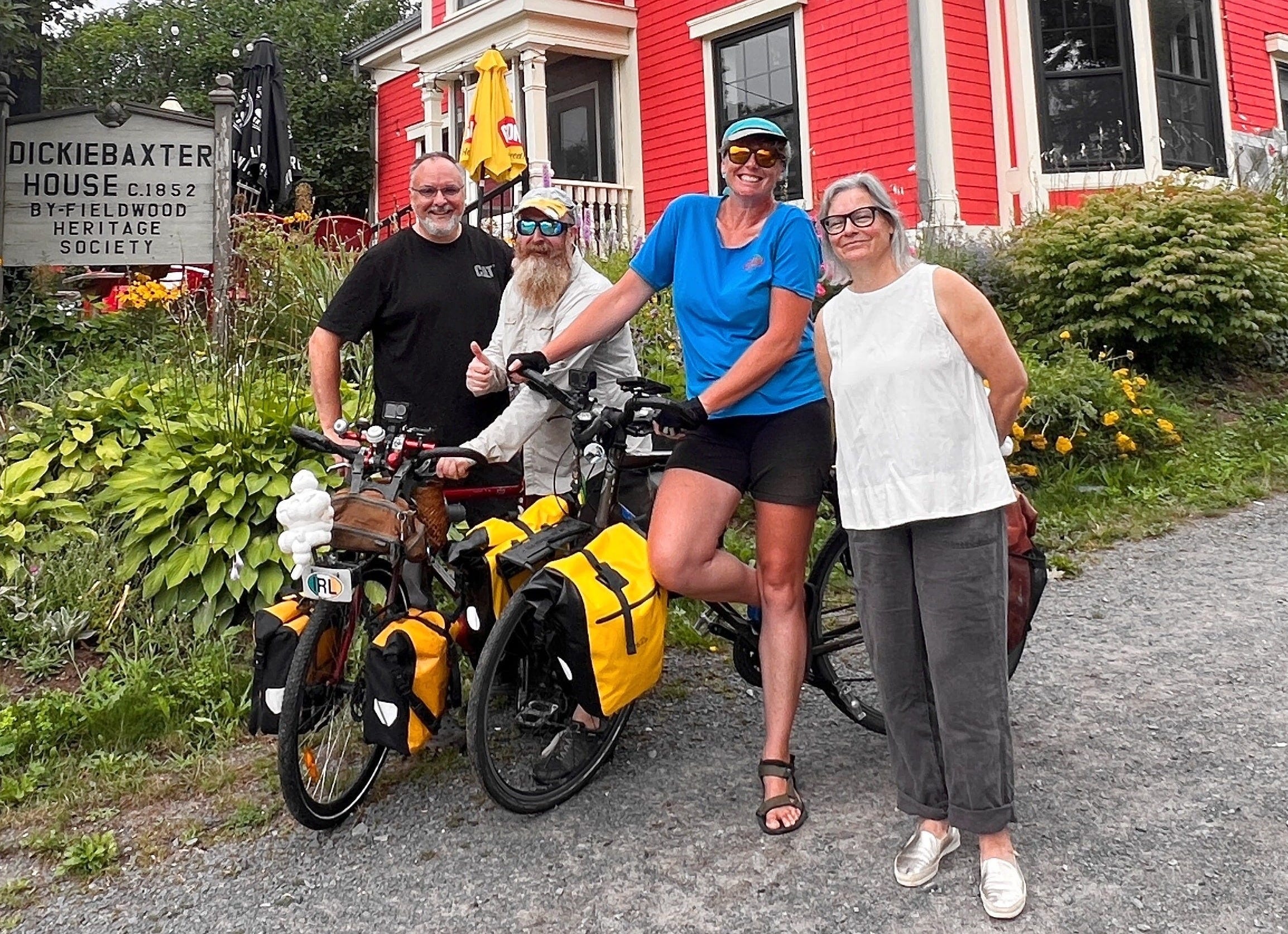
Mark and Ellie rode up our driveway last week with thirty thousand kilometres behind them. Nineteen months around the world, and still going. Two loaded bikes, the kind of loaded where you stop guessing what’s in the bags because the answer is everything. We fed them, gave them a bed, had inspiring conversations and sat up later than any of us planned. In the morning, had coffee, a few more conversations, and they packed and rolled out toward the last leg of the trip. Then, the driveway went back to being a driveway.
That was the meeting. The beginning was a bit more mundane.
Over a year ago, some recommendation engine decided I should see a photo of two loaded bikes. I followed the account the way you follow a hundred accounts, no ceremony, no plan. Mark sent a DM. The DM turned into a post here about the sounds of their trip, goat bells and mountain tunnels, recorded back when their odometer read six thousand kilometres instead of thirty. After that, the occasional comment back and forth. Then months ago, while they were on a different continent entirely, I tossed off the kind of line people toss off: if you ever come my way, stop by.
They kept it. Carried eight careless words across an ocean for a good part of a year, and when their route bent through Nova Scotia, they cashed them in.
Something from this has kept me thinking. That first photo was pushed at hundreds of people. Maybe thousands. The feed didn’t know me from a dentist in Halifax or a guy half-watching the hockey game on TV with his thumb moving. It delivered the same envelope to every one of us.
One driveway.
Mine wasn’t even special. Since they rolled out I’ve been swapping notes with several readers of this publication who took Mark and Ellie in at other bends of the route. Other countries, other kitchen tables. Every one tells a version of the same evening: fed two strangers, sat up too late, came away a little inspired. Some even had the chance to be entertained with some music. And as far as I can tell, most of them found the pair the way I did. A photo pushed at them one day. A follow, then a message.
Nobody ever writes about the people who scrolled past. Busy, tired, or two loaded bikes just aren’t their thing. Nothing wrong with a single one of them. The machine’s job ended at the same place for all of us. It delivered. Delivery is the whole job.
Whatever happened after that was never up to the algorithm. It came down to a half-second where a person decides whether the letter is theirs.
I know that half-second from the other side, and from long before any of this existed.
Late eighties. I was a teenager riding from Ottawa to Boston with two friends, and somewhere in the middle of Vermont we ran out of daylight and nearly out of money at the same time, which is a very specific kind of teenage arithmetic. We stopped at a gas station. A farmer was filling up his truck at the pump, and I asked him if there was a campground nearby.
He said follow the truck.
Not directions. Not six miles up on the left. Follow the truck.
We slept in his spare bedrooms that night. His family fed us a dinner I can still more or less taste, and in the morning a breakfast built on the assumption we’d be riding all day, which we were. There was no internet, no Google Maps, no way to have found that man on purpose. He could have pointed down the road. Pointing down the road is what almost everyone does.
Touring has always run on this current. Dervla Murphy rode from Ireland to India in 1963 and was taken in the whole way by strangers who had no follower counts to check. In 1976, a cyclist named John Mosley started keeping a Rolodex of a few hundred people willing to host riders passing through, and he’d mail photocopied pages to anyone who asked. That Rolodex eventually grew into Warmshowers. The hospitality predates the technology by exactly as long as hospitality predates technology.
The feed plugged into an old current. It didn’t invent the electricity.
So I’ve stopped buying either of the standard stories about the algorithm. The doomers tell me it’s hollowing us out, trading real friendship for the scrolling kind. The boosters tell me it’s knitting the world together. Both stories hand the machine the lead role, and having now watched it work at close range, I think it deserves a smaller part.
It’s the postman. Astonishing logistics, no character. It moved a photo of two bikes from the far side of the world to a screen in Nova Scotia in under a second, a genuine marvel. Also the entire performance. The character in this story was never in the delivery.
I’ll concede the sorting. This postman reads the mail before delivering it. An unsettling habit. It showed those bikes to me because I’m a cyclist who lingers on photos of loaded bikes. It pre-selects an audience already primed to say yes, and deciding who gets which letters is a quiet kind of power that deserves more suspicion than it gets. All of that is true.
But sorting is not answering. The farmer in Vermont got no help sorting; the gas pump did that. And in nineteen months, nobody has fed or provided a bed to Mark and Ellie because a ranking model told them to. The model can put two loaded bikes in front of ten thousand faces. It cannot make one hand reach for the door.
The bikes are gone now. Last leg, Ireland. Dervla Murphy’s home ground, though I doubt they planned the symmetry. The driveway is just a driveway again.
Somewhere in your feed, eventually, there will be two loaded bikes. The machine will have done its part by then. The rest takes about half a second.
P.S. Follow Mark and Ellie at Spoke Yokes if you want to see how it ends.
P.P.S. That Vermont trip ran on luck and one farmer’s goodwill. If you’d rather your own tour lean a little less on luck, Train, Pack & Ride is the book I needed back then and finally wrote. The farmers are optional but recommended ;-)
Super Cool!
I probably came across the spoke yokes the same way you did; one day, they just appeared in my algorithm on Substack. I communicated with them off and over a few months and hoped to meet them, but I think they had to leave the United states to comply with our bizarre visa rules. Not sure. In any event I loved your reference to the half second where the decision is made to interact with others on a personal level. My most recent experience with that was while I was at a local food store and ran into two Bike travelers from the UK who had come up from Key West to Maine using the East Coast Greenway. Whenever I see folks in that situation, I am immediately brought back to situations where I was either in trouble or needed some assistance with shelter food or medical issues on the road and always found kindness. It is really a wonderful community, and whether it’s brought together by a Rolodex or an algorithm really doesn’t matter