


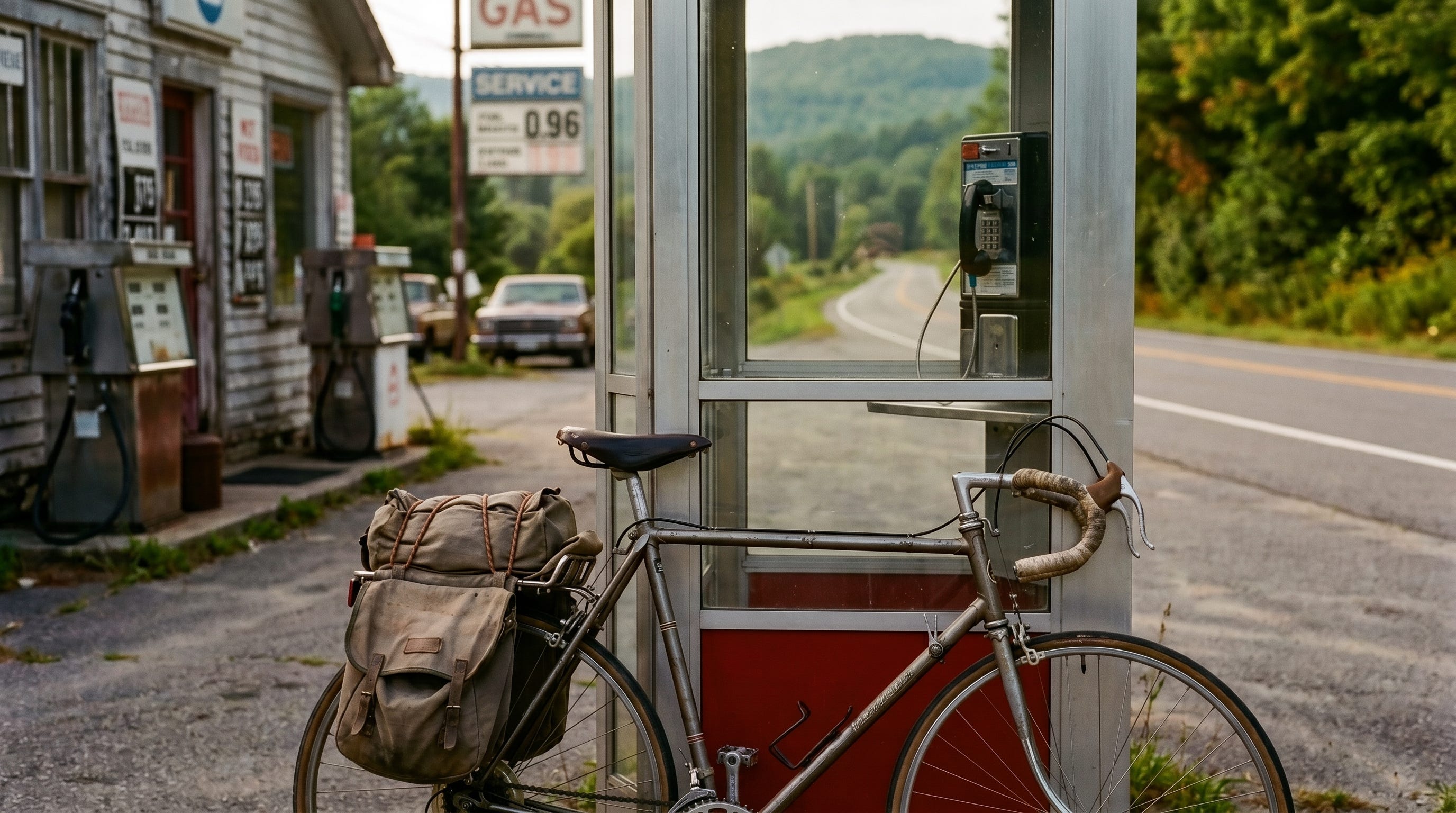
I crossed into Vermont with a pocket full of Canadian quarters.
Nobody had told me American pay phones don’t take them. I found out at a gas station in Derby Line, feeding coins into a slot that spat each one back with a small metallic opinion about my planning. The attendant watched me do it four times before he said anything. Then he sold me a Coke, gave me change in the correct currency, and that was the closest anyone in my family came to hearing from me for the next five days.
I was sixteen. On a great adventure with a couple of buddies. The bike was a Takara ten-speed with downtube shifters and a rear rack I’d bolted on in my parents’ garage with hardware meant for a bookshelf. The map was a CAA road map of Quebec and a gas-station map of New England, folded wrong so many times the creases had become roads of their own. The plan was Ottawa to Boston in eleven days, which I’d announced at the kitchen table and nobody had taken seriously enough to object to.
(The kid who bolted that rack on eventually wrote the book he should have read first. It’s called Train, Pack & Ride, and it covers everything sixteen-year-old me got wrong: the training, the packing, the hardware. The porch-sitting you’ll have to learn on your own.)
For most of those eleven days, no living person knew where I was. Not roughly. Not at all.
My mother knew I’d left Ottawa and intended to arrive in Boston. Everything in between was a rumour. If I’d gone into a ditch outside Hardwick, the first anyone would have heard was a call from a sheriff, days later, after somebody noticed a bike in the weeds. I’m not being dramatic. That was simply the arrangement. You left, you were gone, and then you came back and told people about it, and the telling was the first time the trip existed for anyone but you.
The postcard
I mailed a postcard from Montpelier. A picture of the gold dome on the State House, the only building in town that looked like it might impress my mother. On the back I wrote that I was fine, eating well, and roughly on schedule. Two of those were true.
It arrived in Ottawa four days after I did.
I like that postcard more every year. It’s the only record of the ride that isn’t me, remembering. And it was already wrong when it landed, the way all news from the road is wrong by the time it’s read: the person who wrote it has pedalled out of it.
The call
I phoned home once. Collect, from a Shell station in Plymouth, New Hampshire. The operator asked my name, my mother accepted the charges, and the first thing she said was, “Are you eating?”
Not where are you. Not are you alive. Eating.
I said yes. She said good. We talked for about two minutes, because a collect call in 1988 cost what a motel cost, and then I went back out to the bike. That was the entire surveillance apparatus of the trip: a mother, a postcard, and a vague understanding that I’d show up at my cousin’s door in Somerville on or about the fourteenth.
What I didn’t know I had
I got lost for a day and a half in New Hampshire. A man at a diner swore a road was a shortcut, and it was, to somewhere else. Nobody, including me, considered this an emergency. There was no one to tell. No dot drifting off its line on a screen in Ottawa while my mother decided whether to worry. Just a kid on the wrong road, and the wrong road had a river and a general store with a porch, and I sat on that porch for an hour eating a sandwich, and nobody on earth could have found me if they’d tried.
I didn’t know what that was. I thought it was being lost.
It was the freest I have ever been, and I say that as a man who has since ridden the spine of Portugal with a satellite tracker on his handlebar.
The dot
This past spring I rode six days through the Maritimes with an inReach clipped to the rear bag. Every ten minutes it sent my position to a map Clare could open on her phone. She did open it. She told me afterward she opened it more than she’d expected to, and that the worst part of her week was the four hours on the north shore of PEI when the dot stopped moving.
I was fine. I was in a dead zone eating fish and chips. The device didn’t know that, so neither did she, and for four hours in Canning my wife of thirty-four years sat with a screen that said her husband had stopped.
Nobody had that problem in 1988. The dot didn’t exist, so the dot couldn’t stop.
And every evening of that ride I uploaded the day to Strava, and every morning there were kudos waiting from people I have never met, including, reliably, a man in Belgium. I don’t know who he is. He has a bike and an opinion about my elevation gain. I’d like to tell you I didn’t look. I looked before coffee.
The argument
Everyone says the phone killed the adventure.
That’s lazy. The road is exactly as hard as it was; a hill does not care that you can Google it. What the phone killed is the condition of being unaccounted for. In 1988 the tour was a thing that happened to me and was reported afterward, late, on the back of a postcard. Now the tour is a broadcast with a one-second delay, and a broadcast has an audience, and an audience changes what you do. You still take the general-store porch when the dot is being watched. You just take it a little less, because somewhere a line on a map has gone still and someone who loves you is deciding whether that’s a problem.
Being reachable means being, in some small constant way, responsible. You can never fully leave, because the leaving is being watched.
That’s the loss. Not the adventure. The unaccountedness.
The part I’d rather skip
In 1988 nobody needed me.
That was the actual condition of the freedom, and it had nothing to do with the phone. I was sixteen. There was no restaurant opening at eleven, no staff wondering about Thursday’s schedule, no customer in Maine waiting on a tank of cider. My mother’s “are you eating” was the full weight of the world’s claim on me, and it fit inside a two-minute collect call.
The inReach isn’t for me. I’d leave it in a drawer tomorrow. I carry it for Clare, because I am not sixteen, and my disappearance would now be a problem for other people, and a man who refuses to let anyone worry about him isn’t free. He’s just selfish with a good tan.
So I don’t know. I’ve been writing this for a week and I still don’t know.
Maybe we lost something real, a kind of leaving the dot has made impossible, and we should grieve it instead of calling the tracker a safety feature. Or maybe what I miss was never the silence. Maybe it was being someone nobody would miss.
Did we lose something, or did I just lose being sixteen?
You tell me. The comments are open, and unlike a postcard from Montpelier, I’ll read them the same day.
Writers need maintenance too. If this one landed, a coffee covers mine for the day (American quarters accepted), and the longer rides are all in the books.
Kind of an easy/stupid answer, but we can choose to just disconnect...
I use Polarsteps when traveling by bike. Next time, I think I'll use it only for me, as a travel diary.
I think that by sharing our position, what we are doing, to our family (and stranger) when we travel, we are not completely in the travel. A portion of us is still at home...
I did a four month solo bike tour through Europe in '93. I phoned home once a week, Sunday morning, to let my parents know that I was still alive. No phones, no GPS, just paper maps bought along the way, and learning to say "Help", "How much?" and "Where is the campsite" in several different languages!